
Spiny Softshell, Island 62
life & death on the big river

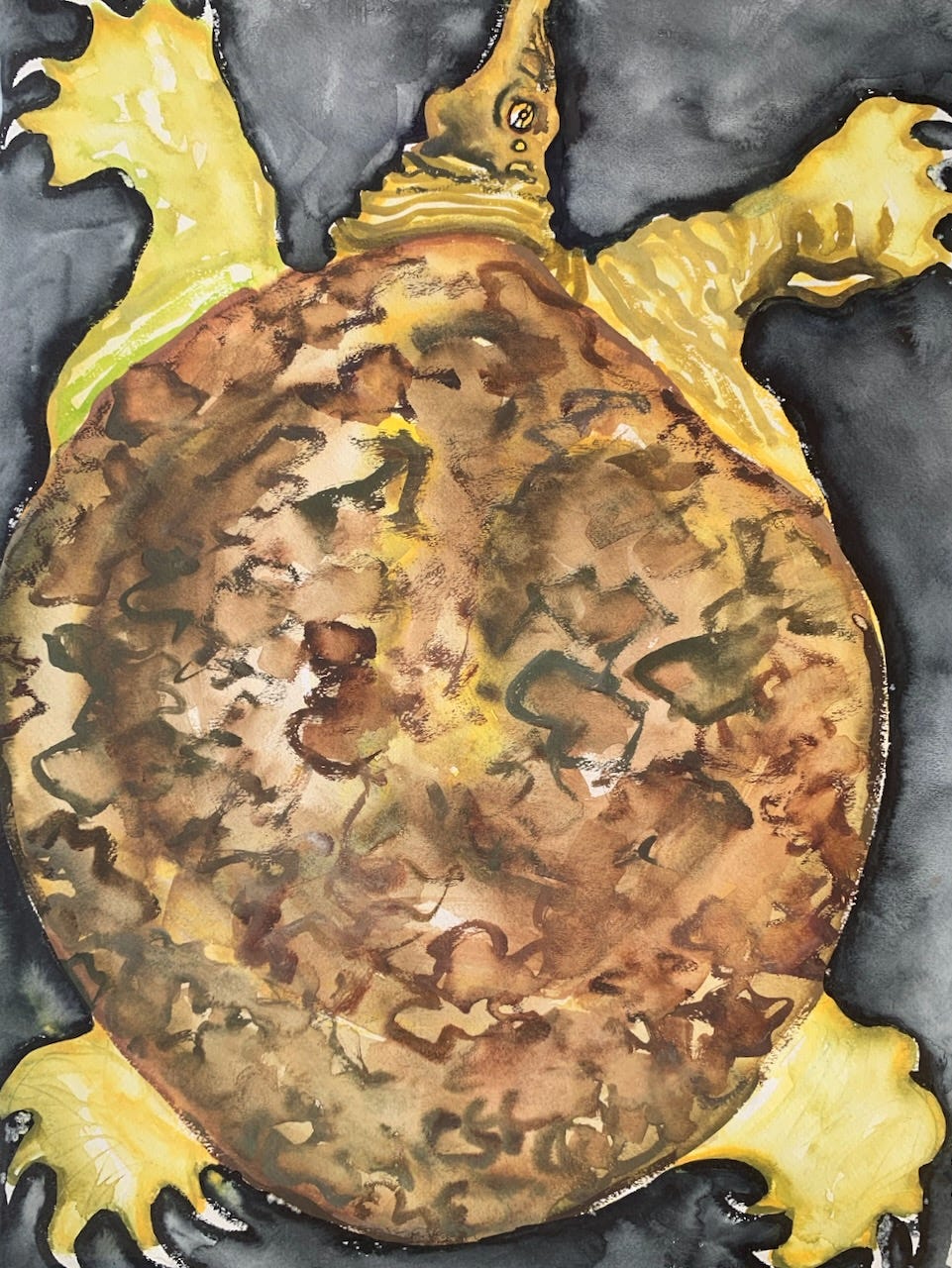
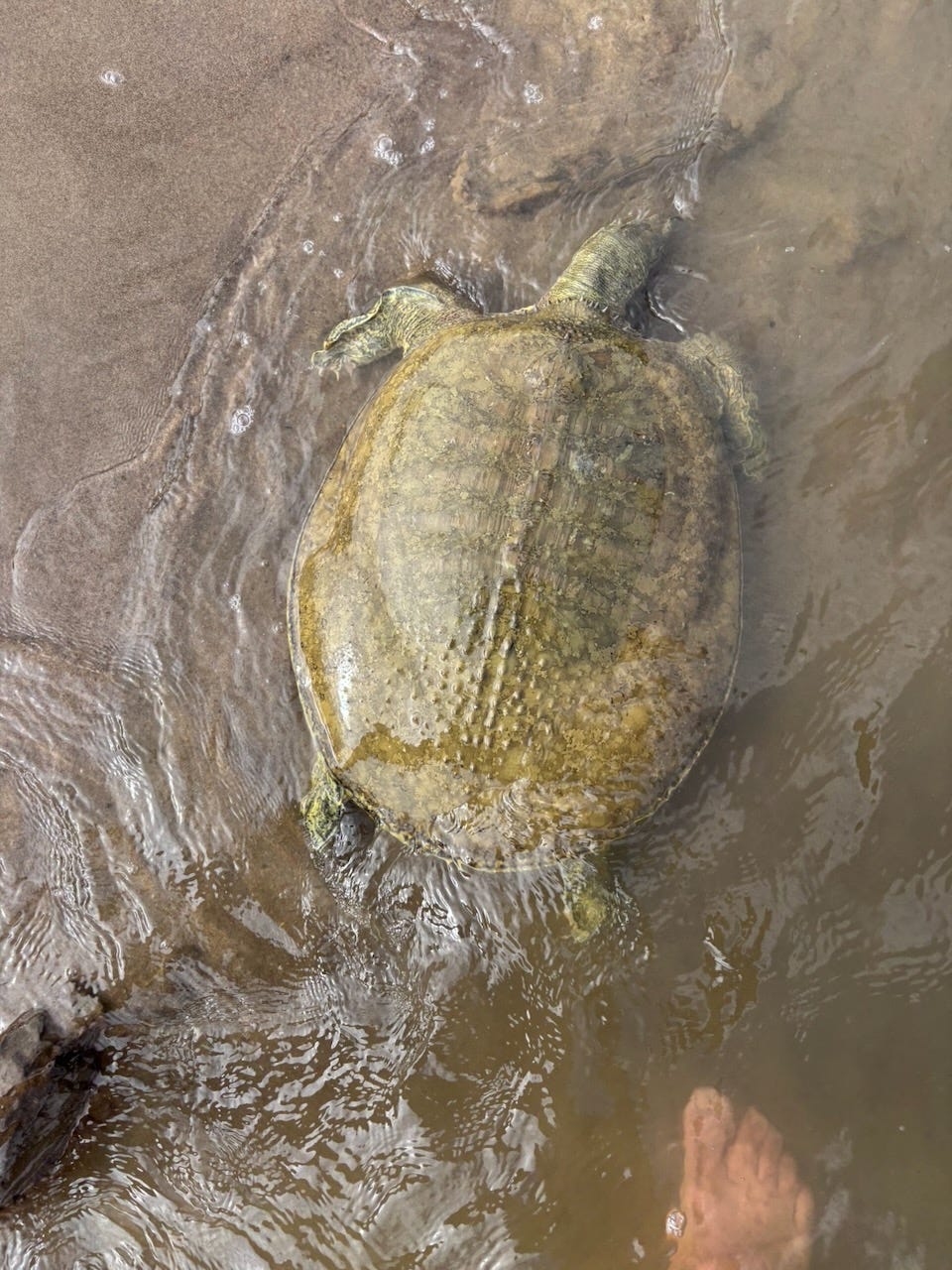
Turtle discovery. Maybe the largest softsthell I've touched. Probably female (grow twice the size of males). For size estimate, my foot in the water. 4" across toes. Turtle is at least 18" long and 12" wide. Cause of death unknown.
~~~Lower Mississippi River Dispatch No. 1042~~~
Since 1995  ~ “Voice of the Lower Mississippi River”
~Quapaw Canoe Company, Clarksdale, Mississippi~
Paddles Up: Thank you Dave & Emma for creating new QCC website at quapawcanoecompany.com!!!! We love it, we love you!


We recently guided an adventurous group of 3 couples from Wales on a mid-summer excursion into the wilds of the archipelago Island 62/Island 63, near Quapaw Landing.  Spirited folks, a lot of fun. We stopped for swims and walks as we paddled along exploring island. There was lots of singing, splashing, and merry-making, like a bunch of kids. The river does that to you.  I served as Captain, Mark River 1st Mate.

Creation was present as we paddled along. The cliff swallows were especially active in the air, although we also noted a few herons, hawks, and vultures.  Also tiger and black swallowtail butterflies, and numerous hackberry princesses.  In the water, dozens of turtle heads dotted the surface, and some fish emerged and swirled their tails.


Paddling the eddies and slow-water upstream, close to shore along Island 62, a large muddy green disk shape caught our attention. A giant spiny soft-shell! We encountered one of the largest soft-shell turtles I have ever got close to. Unfortunately dead. Note design on plastron (belly). Each turtle has a unique geometric design pattern. (One time I found a dried soft-shell whose design looked a lot like Darth Vader's head). We were sad to discover that she had died, perhaps same day. Nonetheless a wonder to behold.


Spines: this is where Apalone the "spiny softshell" gets her name. Look for the array of spiny thorns in above photos -- supposedly for defense -- these ones actually felt soft to the touch, and pliable. Maybe because she had passed?


Your Big Canoe is Waiting! Are you ready for your entry into the wonderland of creation? Through the dense forests of the Mississippi-Arkansas Delta? To the banks of the big river? All you need to do is walk down the ramp. We’ll take care of the rest. Go to our new website and pick out your adventure into the wonders of Mother Nature, via biggest river in North America.
Apalone - the spiny softshells of North America

Trionychidae is a family of turtles, commonly known as softshell turtles or simply softshells. Softshells include some of the world's largest freshwater turtles, though many can adapt to living in highly brackish waters.  Found in Africa, and Asia, our local North American species is known as Apalone, for the spiny points that grow along top of shell.

Apalone is a genus of turtles in the family Trionychidae. The three species of Apalone are native to freshwater habitats in North America; they are the only living softshell turtles from the Americas.

Turtles of the genus Apalone exhibit marked sexual dimorphism. In carapace length, females grow to about twice the size of males. In males, the claws on the front feet are longer than those on the back feet, but in females, the claws on the back feet are longer. In males, the stout tail extends well beyond the posterior edge of the carapace, but in females, the relatively thinner tail barely reaches the edge of the carapace.

(Adopted from Wikipedia.  Click here for photos & more)
More from Wiki: Softshell Characteristics

Turtles of the family Trionychidae are called "softshell" because their carapaces lack horny scutes (scales), though the spiny softshell, Apalone spinifera, does have some scale-like projections, to which its common name refers. The carapace is leathery and pliable, particularly at the sides. The central part of the carapace has a layer of solid bone beneath it, as in other turtles, but this is absent at the outer edges. Some species also have dermal bones in the plastron, but these are not attached to the bones of the shell. The light and flexible shells of these turtles allow them to move more easily in open water or on muddy lake bottoms. Having a soft shell also allows them to move much faster on land than most turtles.[4] Their feet are webbed and three-clawed, hence the family name Trionychidae, which means "three-clawed". The carapace color of each type of softshell turtle tends to match the sand or mud color of its geographical region, assisting in its "lie in wait" feeding methodology.

These turtles have many characteristics pertaining to their aquatic lifestyle. Many must be submerged to swallow their food.  They have elongated, soft, snorkel-like nostrils. Their necks are disproportionately long in comparison to their body sizes, enabling them to breathe surface air while their bodies remain submerged in the substrate (mud or sand) a foot or more below the surface.

Females can grow up to several feet in carapace diameter, while males stay much smaller; this is their main exhibition of sexual dimorphism. Pelochelys cantorii, found in southeastern Asia, is the largest softshell turtle.

Most are strict carnivores, with diets consisting mainly of fish, aquatic crustaceans, snails, amphibians, and sometimes birds and small mammals.

Softshells are able to "breathe" underwater with rhythmic movements of their mouth cavity, which contains numerous processes copiously supplied with blood, acting similarly to gill filaments in fish.[6] This enables them to stay under water for prolonged periods. Moreover, the Chinese softshell turtle has been shown to excrete urea while "breathing" underwater; this is an efficient solution when the animal does not have access to fresh water, e.g., in brackish-water environments.

According to Ditmars (1910): "The mandibles of many species form the outer border of powerful crushing processes—the alveolar surfaces of the jaws", which aid the ingestion of tough prey such as molluscs. These jaws make large turtles dangerous, as they are capable of amputating a person's finger, or possibly their hand.

Unlike the temperature-dependent sex determination of most turtles, trionychids have ZZ/ZW genetic sex determination; microchromosomes play a role in determining sex.

Go to Wikipedia for more description, and photos


Other softshells we discovered on 2025-2026 trips. Note: for each one dead, we see dozens more alive, swimming in the water.
Turtle Shell Anatomy:

Plastron: The bottom or belly portion of the shell, fused with the ribs and sternum.

Carapace: The top, domed portion of the shell that covers the back.

Bridge: The side sections that connect the plastron and the carapace together.

Scutes: The hard, scale-like outer layers of keratin that cover the bony plates of the shell.
Yes brother! Great way to start the Fall season! Who-whoop!
Wonderful trip with incredible people. I've been feeling off for the month of July, with the blistering heat and humidity, but reset my system on this trip just being out on the River. The healing properties are unmatched. Thank God for the Mississippi River. Great post!